Why Treasures Are Too Heavy in Cast a Magnet
Last updated:
Hooking a rare treasure and bringing it ashore are separate challenges. Read the catch's weight, your magnet's capacity and the difficulty label to decide whether your next purchase should be a stronger magnet or more Reel Power.
Upgrade your magnet when lifting capacity blocks a catch; upgrade Reel Power when pulling heavy treasures is slow. After SOMETHING HOOKED, compare Weight with Magnet and read EASY, VERY HEAVY or OVERLOAD. If the result says TOO HEAVY and names a magnet, use that recommendation for the catch. Higher Luck improves rare-find chances but does not remove the lifting challenge.
Strength and Reel Power
Magnet Strength determines lifting capacity. Reel Power speeds up reeling heavy treasures. Choose your next improvement according to the part of the catch that fails.
| Obstacle | Improvement | Purpose |
|---|---|---|
| Insufficient lifting capacity | Stronger magnet | Higher Strength |
| Slow heavy-treasure pull | Reel Power | Faster reeling |
| Rare-find chances | Luck | Rarer finds |
When a TOO HEAVY result names a stronger magnet, save for that equipment. Spending on Reel Power alone does not solve every weight problem: a 672,000 kg Spectral catch still ended in TOO HEAVY with a 500 kg magnet after Reel Power reached Level 5.
Luck helps you encounter rarer treasures, but you still need equipment that handles the hooked item's weight. A high-Luck cast can end with an overweight catch or a slipped line.
Read Weight, Magnet and Difficulty
After SOMETHING HOOKED, read these three parts of the pull screen:
- Weight: the weight of the individual treasure, in kg.
- Magnet: the capacity displayed for your current setup.
- Difficulty: the catch's label, such as EASY, HEAVY, VERY HEAVY or OVERLOAD.
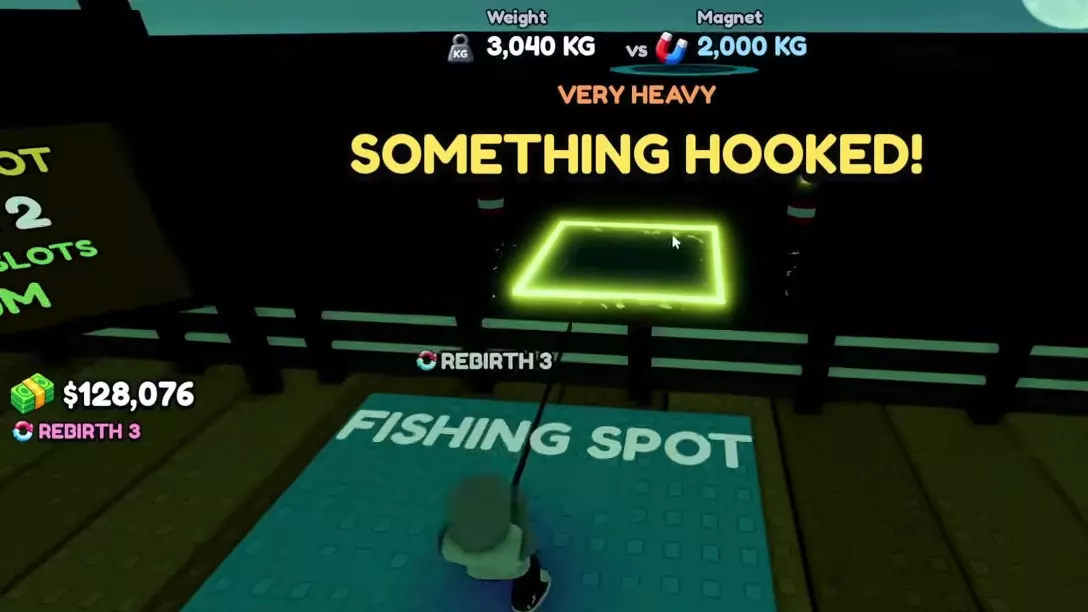
Use the displayed label alongside the weight comparison. Weight above the Magnet number does not automatically mean OVERLOAD: a 3,040 kg catch against a 2,000 kg Electromagnet was VERY HEAVY. A separate 1,481 kg catch against 500 kg displayed OVERLOAD.
Base Strength and fully upgraded capacity
Shop descriptions distinguish base Strength from fully upgraded lifting capacity. Steel Magnet has 120 kg base Strength and 216 kg fully upgraded capacity; Neodymium has 250 kg base Strength and 450 kg fully upgraded capacity.
The shop's Small Safe example for Steel and Motorcycle example for Neodymium use the fully upgraded condition. Compare your current pull-screen value with the actual catch weight when deciding what your equipped setup can handle.
Reel and Choose the Next Improvement
With a treasure hooked and the reeling bar open:
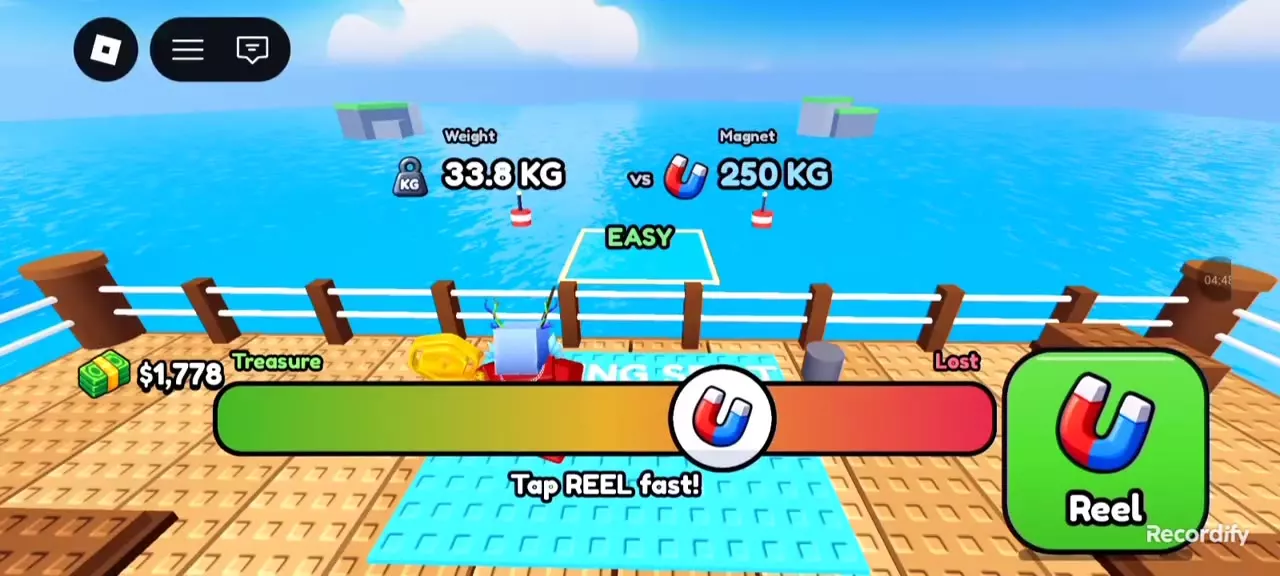
- Reel rapidly. Click rapidly or press Space on desktop. On a touchscreen, tap Reel repeatedly.
- Move toward Treasure. Keep using the reeling input to pull the indicator toward the Treasure end of the bar, away from Lost.
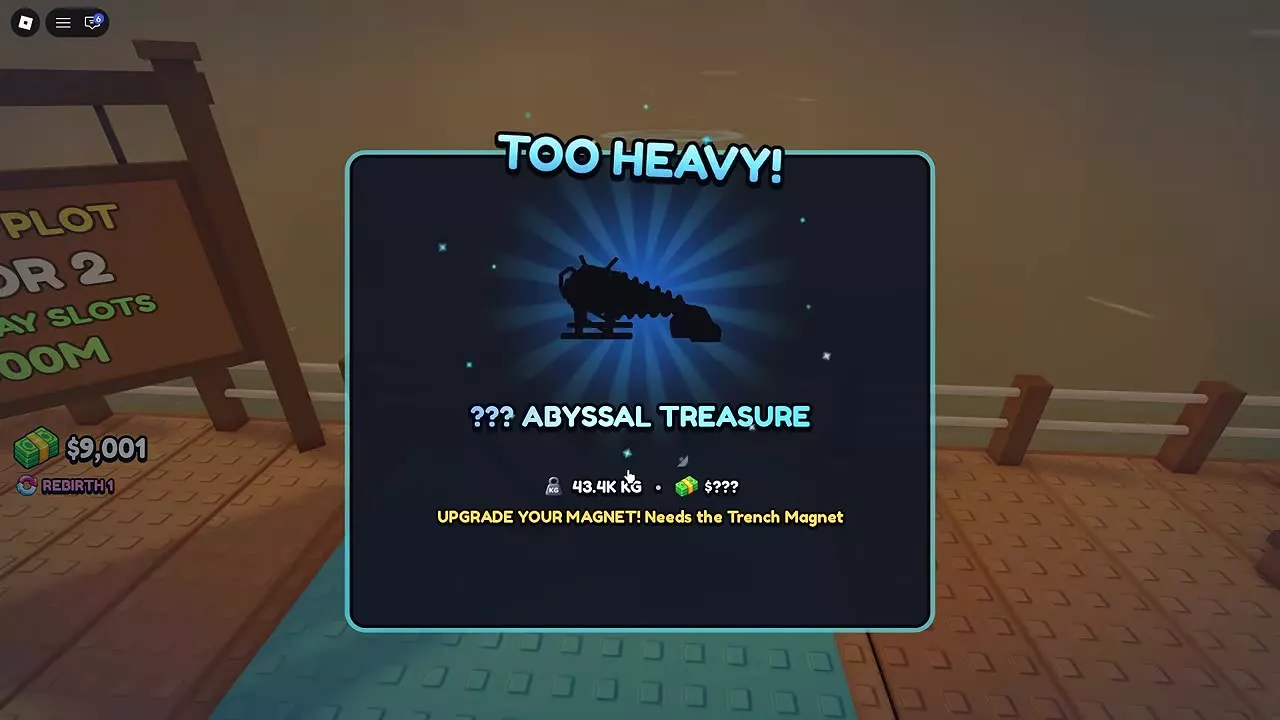
- Read the outcome. A successful catch is added to your Bag. On a TOO HEAVY result, read any named magnet recommendation before dismissing it.
- Address the obstacle. Visit UPGRADES for Reel Power when heavy pulls are slow. For a lifting-capacity problem, use View Magnets at the Magnets stall, compare Strength, and buy or equip a stronger magnet.
Successful machinery and vehicle catches
These catches pair each individual treasure's weight with the Magnet value used during its successful pull:
| Treasure | Weight | Magnet | Difficulty |
|---|---|---|---|
| Portable Generator | 42.0 kg | 120 kg | EASY |
| Motorcycle | 159 kg | 250 kg | EASY |
| Sunken Police Car | 1,203 kg | 2,000 kg | EASY |
| Sunken Sports Car | 1,692 kg | 2,000 kg | HEAVY |
| Sunken Sports Car | 1,489 kg | 8,000 kg | EASY |
The two 2,000 kg catches used Electromagnet. The sports car required a HEAVY pull and was still retrieved successfully; that label does not mean the catch has already failed.
Treasure types have individual weights. Another Portable Generator weighed 40.3 kg and was retrieved with 250 kg capacity, while a 178 kg Motorcycle was EASY with 500 kg. Choose equipment for the hooked item's weight rather than treating a treasure name as a fixed weight or a single-magnet requirement.
For the casting inputs and underwater gate choices that lead into the pull, see the controls and casting guide.
Mythic and Deep-Sea Catch Examples
The following encounters show how rare finds, lifting capacity and failure feedback interact. Each row describes a particular catch.
| Rarity | Catch weight | Magnet | Difficulty | Outcome | Recommended magnet |
|---|---|---|---|---|---|
| Mythic | 3,040 kg | 2,000 kg | VERY HEAVY | Line slipped | — |
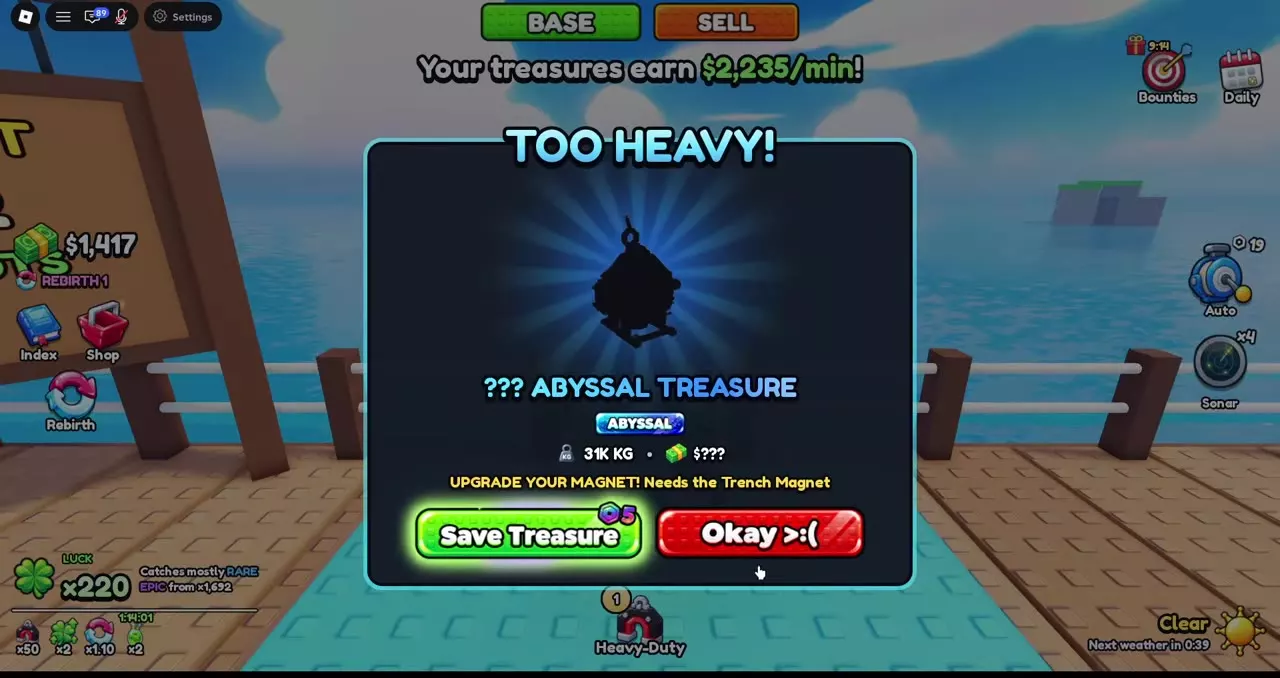
| Abyssal | 31,000 kg | 500 kg | OVERLOAD | TOO HEAVY | Trench |
| Abyssal | 43,400 kg | 500 kg | OVERLOAD | TOO HEAVY | Trench |
| Hadal | 143,000 kg | 120 kg | OVERLOAD | TOO HEAVY | — |
| Hadal | 210,000 kg | 1,000 kg | OVERLOAD | — | — |
| Spectral | 548,000 kg | 1,000 kg | OVERLOAD | — | — |
| Dreadbound | 1,200,000 kg | 120 kg | OVERLOAD | TOO HEAVY | Dutchman's |
Mythic: high Luck still requires lifting capacity
The 3,040 kg Mythic encounter reached a maximum depth of 145 m and Final Luck of 110,530.10×. With Electromagnet displaying 2,000 kg, the pull was VERY HEAVY and ended with IT GOT AWAY! and The line slipped!. Raising Luck enough to hook the treasure did not finish the catch.
Abyssal: follow the Trench recommendation
Both the 31,000 kg and 43,400 kg Abyssal results named Trench Magnet. For these catches, the result points directly to a magnet purchase. Use the recommendation for the individual catch rather than treating every Abyssal treasure as the same weight.
Hadal and Spectral: compare the full setup
The 143,000 kg Hadal encounter used a 120 kg magnet and a maximum depth of 55 m; the descent included Luck of 108.08× at 47 m. It ended in TOO HEAVY without collecting the treasure.
The separate 210,000 kg Hadal encounter reached 115 m and Final Luck of 5,956.50× with a 1,000 kg magnet, then displayed OVERLOAD. The 548,000 kg Spectral encounter also overloaded a 1,000 kg magnet after Luck rose from 1,350.24× to 3,425.48× during descent.
These are different catch configurations. Their depths and Luck readings describe those encounters, rather than minimum requirements for finding either rarity.
Dreadbound: the result names Dutchman's Magnet
The 1,200,000 kg Dreadbound encounter used a 120 kg magnet. Its descent included Luck of 72.66× at 47 m, followed by OVERLOAD and TOO HEAVY. The result recommended Dutchman's Magnet for that catch.
Slipped Lines and Save Treasure
IT GOT AWAY! with The line slipped! identifies a failed pull. TOO HEAVY identifies the overweight result; its panel also provides the equipment recommendation when one is given.
Save Treasure
Find Save Treasure on the failure result panel, beside Okay on the slipped-line result or Okay >:( on the TOO HEAVY result.
To close the result and continue playing:
- Read the weight and any recommended magnet.
- Select Okay or Okay >:(.
- Return to casting, or change your equipment before the next attempt.
Magnet and Upgrade References
- Magnet list, stats and unlocks: compare target prices, Strength, Luck and Rebirth requirements.
- Which magnet to buy next: choose a purchase for your budget and current lifting needs.
- Luck, Rope Length and Reel Power upgrades: compare upgrade purposes and follow the links to their level tables.